Spoiler Alert (Kind Of)
Preached by Jason Abbott
September 14, 2014
In Hollywood, there is a certain type of film that’s very subject is a spoiler. Typically, these films are depicting some well-known history about which nearly everyone knows the ending: Pearl Harbor (Surely there won’t be a secret attack!), Nixon (Holy Cow! Did anybody in the theater see Watergate coming? Surely not!). Yet, by far, the most notorious and successful of these kinds of movies is 1997’s record setting blockbuster film: Titanic—I mean, what nincompoop went into the movie theater like: “I’ll bet they don’t sink this time!”?
Now, since this is without question the case with such historical movies—that everyone who goes to them goes knowing exactly how the movie will end—we must ask: Why does anyone go to see them at all? Why is Titanic still the second highest box office draw of all time?I believe the answer to such questions is that, even though we know the end (in fact, perhaps even because we know the end); we go in order to see how people will behave as that inevitable conclusion approaches, and how they will behave even in the midst of that conclusion: Will the characters act courageously or not? Will they act selflessly or selfishly when confronted with the end?Human history—whether we embrace it or not—is much like these films. There is an inevitable conclusion approaching; Jesus, God the Son, is coming back. When he does, this sinful, rebellious epic in the history of creation will conclude. Knowing this ending, however, shouldn’t squelch interest in the redemptive story; rather, it should focus our attention on how we will live in light of that conclusion. Will we act courageously or not? Will we act selflessly or selfishly when confronted with the end?Well, let’s look at today’s text and see what Jesus teaches about such things.
Mark 13:28-37
28
“From the fig tree learn its lesson: as soon as its branch becomes tender and puts out its leaves, you know that summer is near.
29
So also, when you see these things taking place, you know that he is near, at the very gates.
30
Truly, I say to you, this generation will not pass away until all these things take place.
31
Heaven and earth will pass away, but my words will not pass away.
32
“But concerning that day or that hour, no one knows, not even the angels in heaven, nor the Son, but only the Father.
33
Be on guard, keep awake. For you do not know when the time will come.
34
It is like a man going on a journey, when he leaves home and puts his servants in charge, each with his work, and commands the doorkeeper to stay awake.
35
Therefore stay awake—for you do not know when the master of the house will come, in the evening, or at midnight, or when the rooster crows, or in the morning—
36
lest he come suddenly and find you asleep.
37
And what I say to you I say to all: Stay awake.”
I suppose I could have made this point in week 1 of our 3 weeks in Mark 13, but I felt I was already doing so much (reintroducing Mark, outlining the chapter, oh…and preaching the first 13 verses!!) that I decided to wait until now to make it. Better late than never, I guess.It is essentially a point about vocabulary, but it should help you see how Benjamin and I have decided to designate certain verses as about the temple and certain verses as about the second coming of Jesus.So, let me draw your attention for a moment to:
1. The difference between these and those
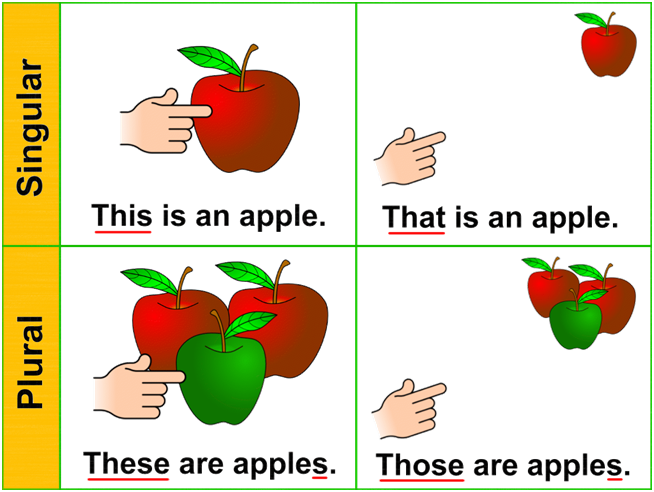
These and Those
If you can remember grade school English lessons then you might remember some lesson in which you were taught the distinction between these two pronouns. For those of you who are not able to remember back that far, I’ve acquired a visual aid from such a lesson in order to help you.1Notice, in the diagram, that the pronoun these refers to things that are near while the pronoun those refers to things that are distant. So too, the pronoun this refers to a thing nearby while the pronoun that refers to a thing more distant.Here is the importance of this primary school grammar lesson for us today—Jesus, throughout chapter 13, has been using these, those, and that to teach about future events which are nearer and future events which are more distant.Just look at the passage with me:
In verse 4, some disciples ask Jesus—When will these things be, and what will be the sign when all these things are about to be accomplished. By these things, the disciples certainly mean the temple’s destruction.
Jesus then, in verses 5-13, starts to answer the question about the temple. So he describes the events surrounding the temple’s destruction saying—These [events or things] are but the beginning of the birth pains (v. 8).
But, in verses 14-27, there’s a distinct pronoun shift from these to those, from events that are nearer in time to events that are more distant in time. So Jesus describes events taking place in those days (vv. 17, 19, 20, 24).
This is simply to say that, as you read Mark 13 with an eye on its pronouns, you’ll get verbal clues as to whether Jesus is referring to the temple’s destruction or his second coming.Today’s passage is consequently a prime example of this.In verses 28-31, Jesus moves back once again to a discussion of these things. This shift is a clue (as I read it) that Jesus is again discussing the temple’s demise. In fact (as I read it) that is the most natural understanding of what Jesus says here. Consider verses 29 and 30:
[When] you see these things taking place, you know that he is near, at the very gates. Truly, I say to you, this generation will not pass away until all these things take place
(vv. 29-30).
Here, we feel the full weight of the pronoun shift from those back to these, from distant events to nearer events, and we simultaneously feel the full need for it. For if Jesus were still talking about his second coming here, what would we do with verse 30?
This generation will not pass away until all these things take place
(v. 30).
If he’s talking about his second coming then that generation did pass away before he returned (and Jesus would have been wrong!), but if he’s instead talking about the temple’s destruction then Jesus was surely right! Pronouns are important.Yet, Jesus has not finished talking about his second coming or the end times. He consequently shifts (in verse 32) back to a pronoun with a more distant scope. Look at that verse with me:
But concerning that day or that hour, no one knows…
(v. 32).
That is simply the singular pronoun which corresponds with the plural those. Furthermore, the words “‘Day’ and ‘hour’ are often charged with eschatological [or end times] meaning in the Bible.”2What we have here, in verse 32, then, is a firm move back to the discussion of the final day when Jesus will do away with sin and death, pain and suffering, everything evil…forever!Now, why on earth did I take you through this discussion about pronouns? What’s the take away? Let me give you two applications:
First, I hoped to bring some clarity to the question of how we might read and study and understand Mark 13 and being aware of the pronoun shifts can be (I believe) a helpful part of doing so.
Second, don’t despise small things or details whether studying Scripture or writing a note to a coworker or listening to somebody tell you things about his or her day. The smallest things, the smallest details, can be supremely import.
Well, let’s move to our last two points which are more about what Jesus said and less about how Jesus said it. Let’s think theology.
2. The Son doesn’t know?
Jesus says something here that should (if you’re awake) give you pause. Look at the passage with me again. Talking about the timing of his second coming, Jesus (God the Son) says:
But concerning that day or that hour, no one knows, not even the angels in heaven, nor the Son, but only the Father
(v. 32).
How, we might rightly ask, can Jesus not know this and still be fully God? While we’re at it, we might ask how can Jesus get tired, which he did (John 4:6), and still be fully God, or how can he die, which he also clearly did (Mark 15:37), and simultaneously still be fully God?The answer is that Jesus is both truly and fully God and truly and fully man. The answer is the mystery of the incarnation—that God the Son put on flesh and walked among us. You see:
“Jesus purposely laid aside temporarily the exercise of his omniscience as part of what was involved in his becoming [truly] man.”3
Jesus purposely laid aside temporarily the exercise of his omnipotence as part of what was involved in his becoming truly man.
Jesus purposely laid aside temporarily his rightful claim to eternal life, and really died, as part of what was involved in his becoming truly man.
So, in a mindboggling and mysterious nutshell, that’s what’s going on here. Jesus identifies with each of us through the truly human attribute of ignorance—the attribute of limited knowledge.Ironically, this passage, which often shakes people’s confidence in Jesus, was intended to be (and should be) a great encouragement to all who follow him. See, the disciples have essentially cried out: “We want to know, give us a sign! When are all these things going to take place?”To their cry, Jesus responds by telling them about the road that lies ahead; Jesus responds by telling them about the ultimate end of all things, his return; however, ultimately Jesus says: “You cannot know the time and neither can I.” And, in that, Jesus is saying: “I share this with you.”Have you ever been suffering in some way? Have you ever been in a pinch? When you are, what kind of counsel gives you the most calm and encouragement? Counsel from one who has been there, right? Well, here, Jesus is essentially assuring us of that very thing, and it is supposed to encourage us.Yet, by identifying with us in this way, by identifying with our vulnerability, Jesus isn’t merely saying I understand, but, additionally, he’s saying: “Follow me. I am your God, and I am your older brother in these things. I’m your example!”Let me explain how Jesus is our example in our final point:
3. Not a sign, a Someone
What do I mean by this? Well, perhaps the best way to answer that question is to ask another question—Who isn’t asking for a sign here?The answer to that question is obvious: Jesus is the one not asking for a sign. Like the disciples and us, he confesses that he doesn’t know the date of his return. He shares in our ignorance of such things, but he never asks for a sign or a date. Why is that?I think it’s because he has a Someone—he has a Father in whom he trusts. Jesus has a perfect, sovereign Father whom he knows loves him without limits. And, when you have such a Father, how much better is that than signs!
Jesus essentially says: “I don’t know the date, but my perfect Father does. And that’s enough for me. So, follow my example as I serve him!”
Jesus tells his disciples: “You and I don’t know when I’ll return and put an end to this sin laden world, but our Father does and that should be more than enough for us! So, trust in me and serve him!”
Ever since our first father and first mother sinned against God in the Garden, our problem has been trusting God with what we do not know about creation—trusting that he is good and truly knows what’s best for us!But, even in this passage, we see that Jesus succeeds where we have failed. We see Jesus trusting and obeying God the Father perfectly in ways we have not. We see, in Jesus, the person we are not but should be.But, don’t despair, for Jesus is much more than an example for each of us, he’s also our savior through faith. If you trust in him, his righteousness is for you; his death is for you; his resurrection is for you; and, when he returns it is for you. This is the good news. So, trust and serve the Father even as Jesus is about to!
1
See http://english.eagetutor.com/spoken-english/the-right-use-of-this-that-these-those by Chander Madan.
2
James R. Edwards,
The Gospel According to Mark
, 406.
3
Walter W. Wessel,
The Expositor’s Bible Commentary: Mark
, 753.